
Copper Gods
Sacred Forms at the Edge of the Anthropocene
By Scott Cressman
A photography monograph that reveals deities at the edge of America’s most toxic lake.
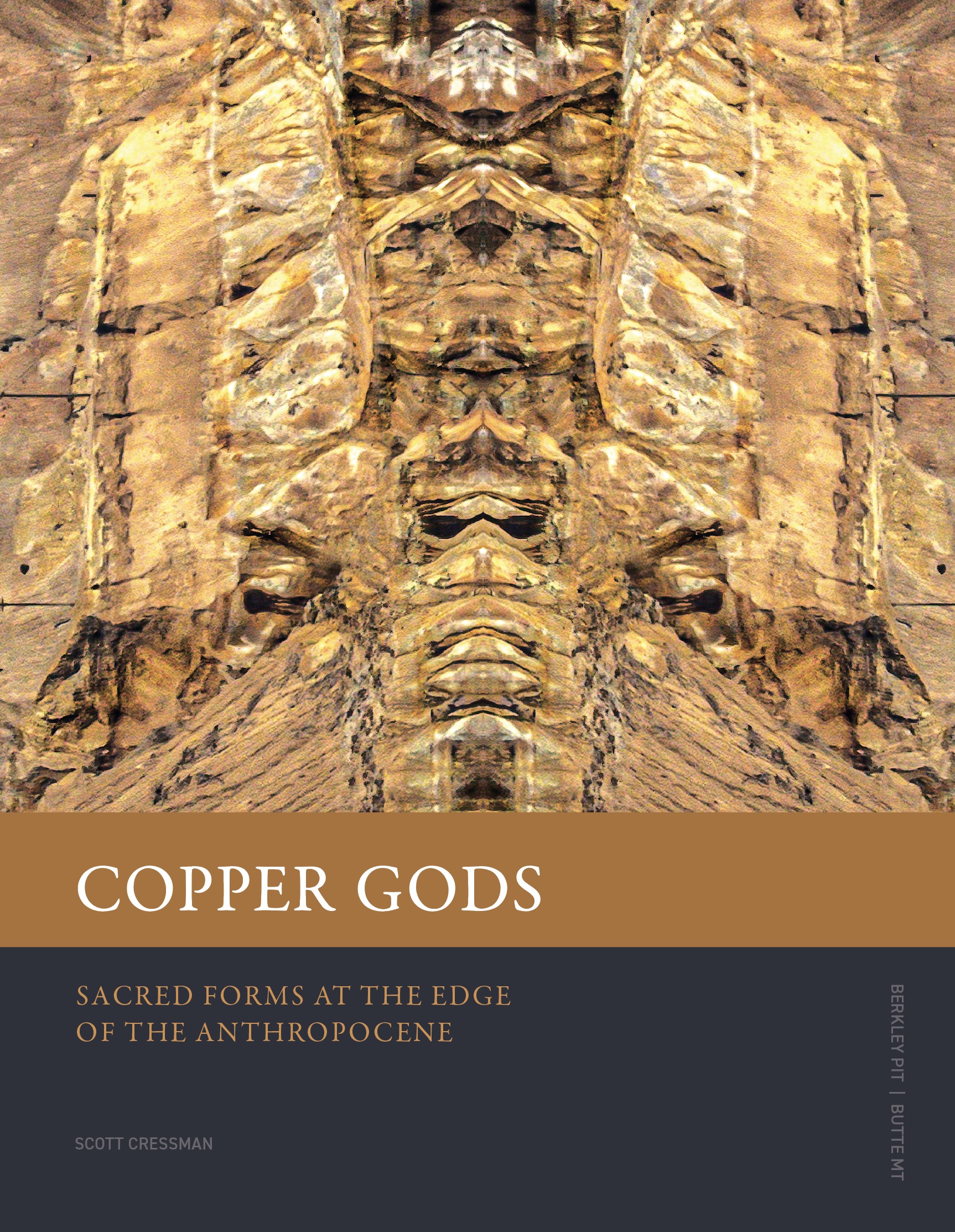
Copper Gods is a fine art photography monograph — part visual discovery, part perceptual science, part geological document, and part meditation on what industrial damage accidentally makes possible. Photographed at the Berkeley Pit in Butte, Montana — one of the most consequential environmental sites in North American history — this book asks a question: what happens when you hold a mirror up to a Superfund site?
The answer is a pantheon. Faces of unmistakable authority staring back from the acid-stained rock. Warriors. Masks. Presences of ancient power composed entirely of iron oxide, manganese black, and copper blue — the mineral residue of a century of extraction, organized by chemistry and geology into something the human visual system cannot help but recognize as sacred.
Nothing was added. Nothing was invented. Everything you see was already there, waiting.
Copper Gods is a monograph — twenty-four large-format bilateral mirror photographs accompanied by a full critical text. Inside:
- Twenty-four bilateral mirror photographs of the Berkeley Pit walls and waterline reflections
- A history of the Berkeley Pit — its human cost, its displaced communities, its ongoing environmental consequences
- The geological story of the pit’s extraordinary mineralization
- The perceptual science behind what you see — Gestalt psychology, pareidolia, closure, and why the human visual system cannot look at these images without finding a face
- The ancient lineage of found imagery — from Paleolithic cave painters to Leonardo da Vinci, Max Ernst, and Salvador Dalí
- A meditation on beauty and damage, the Anthropocene sublime, and what it means to find the sacred in the geological
- Individual critical readings of all twenty-four plates, each connecting the specific mineral chemistry of the image to its visual and cultural meaning
- A geological colour reference — the twelve mineral compounds that paint the Berkeley Pit walls, and what each one contributes to the images
The Berkeley Pit is a mile wide, nearly two thousand feet deep, and filled with forty billion gallons of toxic water. It is the most expensive Superfund remediation project in American history. For a century and a half it has been called an engineering marvel, an environmental catastrophe, a cautionary tale, and a wound.
Copper Gods proposes something different. Not a verdict on what happened here, but a sustained act of attention to what it made — and what looking at it carefully, with the right tools and the right questions, actually reveals. The figures that emerge from the pit walls are not gentle. They carry the burden of the landscape that produced them. But they open a space of genuine encounter. They ask to be looked at. And they look back.
This book asks for a willingness to hold the full complexity of a place — its damage and its extraordinary beauty — in the same moment of attention.
About the author
Scott Cressman is a Canadian photographer, designer, and Assistant Professor of Communication Design at Alberta University of the Arts in Calgary. He came to the Berkeley Pit with two sets of eyes: those of a photographer and those of a former geological technician who worked in Canada’s eastern Arctic in the early 1980s for Urangesellschaft mbH. That early career experience brought contact with Canada’s Inuit — communities whose relationship to land as a living presence shaped the way he has looked at nature and landscape since.
His photography is represented through Getty Images. His work is displayed in the Supreme Court of Canada. He is the founder of Neurocreative, a research initiative dedicated to reframing neurodiversity as a creative strength, and the author of Designed to Diverge: ADHD and the Art and Design Student. He is currently completing The Mirror That Woke: Existence, Mind, and the Universe Coming to Know Itself.
Forthcoming 2028
© 2026 Scott Cressman. All rights reserved.