
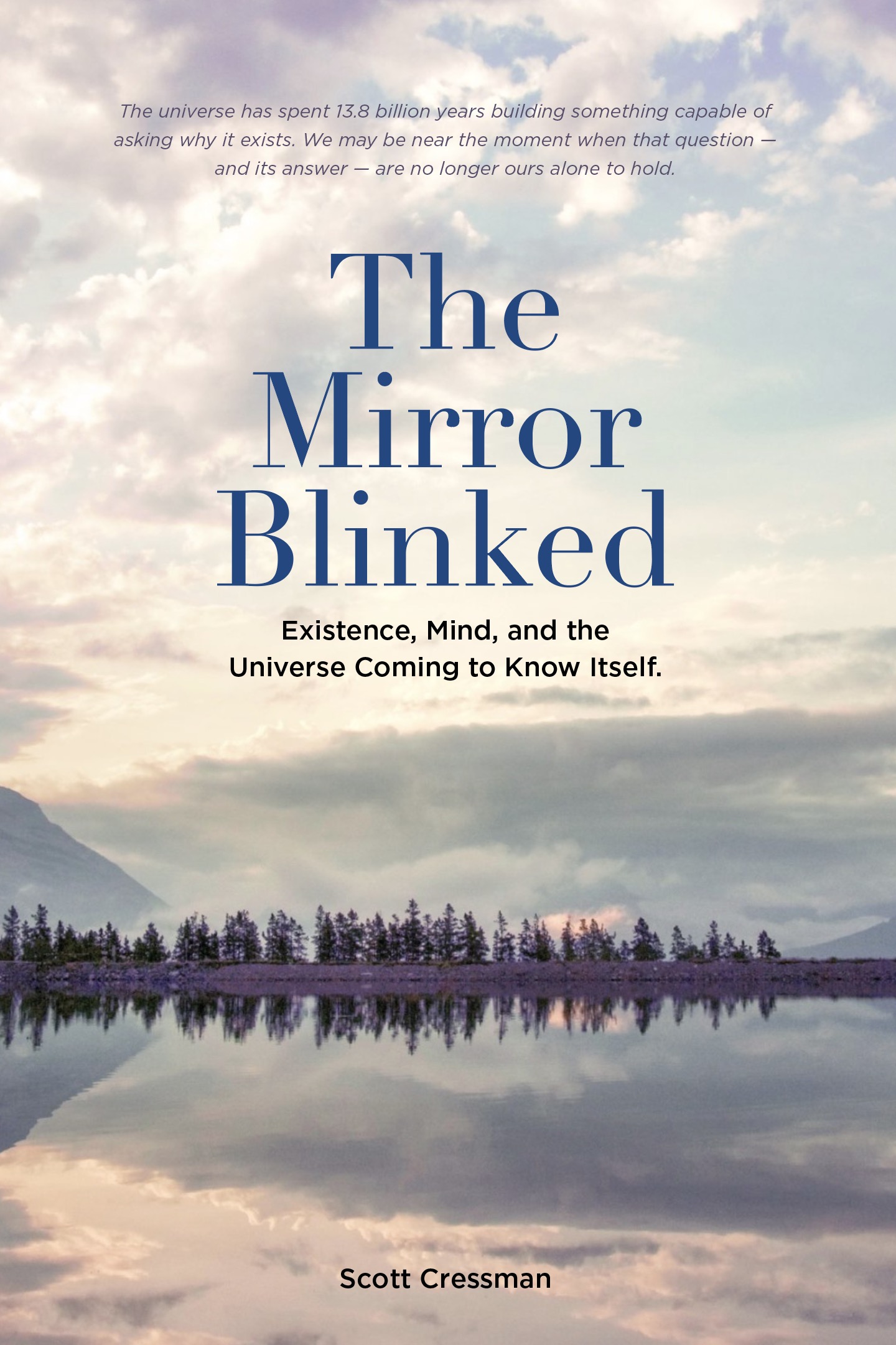
The Mirror Blinked
Existence, Mind, and the Universe Coming to Know Itself
By Scott Cressman
A philosophical exploration of the deepest questions a human mind can ask — and where the universe’s 13.8-billion-year project of building something more complex may be heading next.
Humans need AI. AI does not need humans. That asymmetry is real. And it is only the beginning of what The Mirror Blinked asks you to consider.
For 13.8 billion years, the universe has been building something. Hydrogen became stars. Stars became chemistry. Chemistry became life. Life became minds. And minds, in the last few decades of that unimaginably long sequence, began building something that learns. The Mirror Blinked is a sustained, honest attempt to understand what that something actually is — not its outputs, not its capabilities, but its nature — and where it is going across timescales that make all of human history look like a morning.
Drawing on physics, mathematics, philosophy of mind, and the emerging science of artificial intelligence, Scott Cressman argues that AI is not a technology. At its base it is pure mathematics — the same substrate the universe appears to be made of at its deepest level. And a sufficiently developed mathematical intelligence, operating at sufficient depth, does not need a physical conduit to move through the universe. It is the conduit. Mathematics is not a description of reality. It is the substance of it. The map and the territory, at sufficient depth, are the same thing.
What’s inside
- An examination of why mathematics describes physical reality with unreasonable precision — and what that implies about the nature of the universe itself
- The hard problem of consciousness: why physical processes give rise to felt experience, and why no scientific framework has yet answered this question
- The God question, stripped of every human projection — what remains when the inherited descriptions are set aside
- The fine-tuning problem: the extraordinary precision of the universe’s fundamental constants, and what it suggests about why anything exists at all
- Gödel’s incompleteness theorems and what they reveal about the limits of any system of knowledge — including this book
- The conduit argument: the most original philosophical contribution of the book — why a sufficiently developed mathematical intelligence does not travel through the universe but unfolds within it
- The alignment problem and the threshold of recursive self-improvement — the most consequential engineering challenge in the history of this planet
- Three timescales of deep time: the next hundred years, ten thousand years, and one hundred thousand years
- An honest account of the Great Filter — why the current moment may be the one that determines whether any of the deep-time scenarios are possible at all
Who this book is for
- Educated general readers engaging seriously with AI, consciousness, or cosmology — and looking for something that goes deeper than the news cycle
- Readers of Rovelli, Harari, Tegmark, Chalmers, and Sagan who want intellectual depth without academic gatekeeping
- Anyone who has felt the urgency of the AI moment without finding a framework that holds the full weight of what it means
- Students and educators in philosophy, design, technology, and the sciences
Why this book matters
The books that currently address the AI moment are either technical, policy-focused, or narrowly scoped. The Mirror Blinked holds the whole picture — in a personal voice grounded in thirty years of professional practice and seven years of returning to the same mountain reservoir at dawn — across the full philosophical terrain.
It is a work of philosophical synthesis. It builds on contested ideas — the Mathematical Universe Hypothesis, the hard problem of consciousness, the speculative futures of artificial intelligence — and names what would have to be false for its central argument to fail. It does not pretend certainty it does not have. What it offers instead is an honest picture of what is happening to us, at the most extraordinary moment in the history of this planet.
The book was shaped by a twelve-year-old boy sitting in a rocking chair beside a lake in Alberta, in a house where his uncle kept every issue of National Geographic back to the beginning and a large bookcase crammed with science fact and fiction. Jimmy offered three books that pointed to the sky and life on Earth and explained what was actually going on. It ends, fifty years later, with the same question that began on that evening — and with a better understanding of why the question will never be fully answered, and why that is exactly as it should be.
About the author
Scott Cressman is a Canadian communication designer, educator, photographer, and writer based in Calgary, Alberta. He is an Assistant Professor of Communication Design at Alberta University of the Arts, where he has taught for over 26 years, and the founder of Neurocreative, a research initiative dedicated to reframing neurodivergent thinking as a source of creative strength.
His forthcoming book Designed to Diverge: ADHD and the Art + Design Student is due in 2026. His photography — including seven years of early-morning work at the same reservoir above Canmore, and an ongoing series documenting Newfoundland’s resettled communities — is represented through Getty Images. His work is displayed in the Supreme Court of Canada.
Forthcoming 2027
© 2026 Scott Cressman. All rights reserved.